Nothing Broke. Everything Was Breached
Why the W3LL phishing-as-a-service takedown matters for Singapore.
Cyberpunk Writer
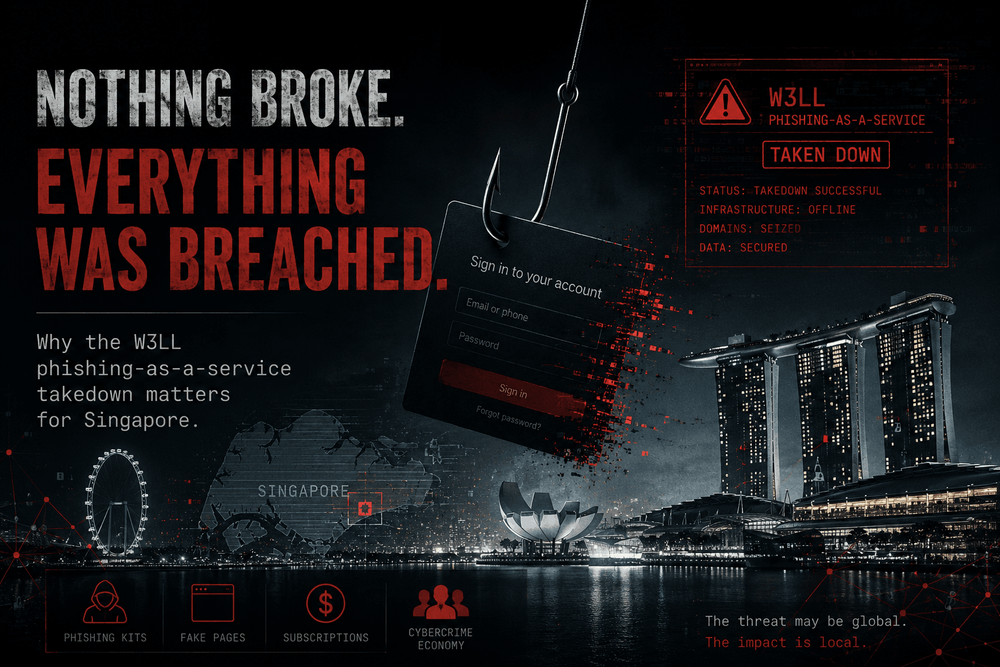
W3LL Takedown: A Question Mark for Singapore
In April 2026, the takedown of W3LL, a polished phishing‑as‑a‑service marketplace, looked, at first glance, like a clean win. International investigators seized infrastructure, disrupted supply chains, and peeled back the curtain on a cybercriminal ecosystem that had quietly scaled to thousands of victims worldwide.
But in Singapore, the story doesn't quite land as closure. It lands as a question mark.
Because W3LL wasn't just a toolset. It was an operating model, one that maps almost perfectly onto how Singapore works.
At the core of W3LL's appeal was its ability to industrialize adversary‑in‑the‑middle attacks. Instead of simply harvesting passwords, its kits intercepted live login sessions, capturing authentication tokens that let attackers slip past multi‑factor authentication. To the victim, everything looked normal. To the attacker, the door was already open.
That distinction matters in a place like Singapore, where "secure by default" is a national ethos. Enterprises roll out MFA across Microsoft 365. Government-linked companies enforce conditional access. Employees are trained repeatedly not to click suspicious links.
And yet, the architecture of trust remains email.
Picture a regional finance team in Raffles Place. An accounts manager receives what looks like a routine message from a supplier in Jakarta, branding intact, tone consistent, timing plausible. The link leads to a Microsoft 365 login page that behaves exactly as expected. Credentials go in. MFA prompt appears. Access is granted.
Nothing breaks. Nothing is alerted.
Except somewhere else, an attacker is now reading the same inbox, drafting replies, and inserting themselves into payment conversations that span Singapore, Manila, and Ho Chi Minh City.
This is the environment W3LL thrived in: not weak systems, but highly connected ones.
Singapore's role as a regional headquarters hub makes it uniquely exposed. A single compromised mailbox in a logistics firm in Jurong can ripple across shipping partners in Batam. A hijacked account in a fintech startup at One‑North can be leveraged to target investors, clients, and regulators across jurisdictions. The attack surface isn't just local — it's networked, layered, and constantly in motion.
That's why the absence of Singapore in public victim lists is almost beside the point.
W3LL's campaigns were never about geography in the traditional sense. They were about platforms such as Microsoft 365, cloud identity systems, and browser sessions. If your organization runs on the same stack as everyone else, you're already inside the threat model.
And Singapore, with its near-universal adoption of these tools across government, finance, logistics, and tech, is deeply inside that model.
There are hints of this in the data that does surface. Singapore has seen persistent waves of business email compromise, often involving invoice manipulation and impersonation of trusted partners. Authorities have warned of attackers inserting themselves mid‑conversation, altering bank details just before payments are executed. These aren't theoretical scenarios. They're operational patterns.
What W3LL did was make those patterns scalable.
It lowered the barrier to entry for attackers who didn't need to understand the intricacies of session hijacking or MFA bypass. They could simply buy access to a kit, follow a playbook, and plug into a global ecosystem of phishing infrastructure.
In that sense, the takedown of W3LL is less like shutting down a gang and more like closing a marketplace. The vendors disappear. The demand doesn't.
For defenders in Singapore, the implication is uncomfortable but clear. The security model that prioritizes credentials, even with MFA layered on top, is no longer sufficient against attacks that operate after authentication. Visibility has to shift toward session behaviour, anomaly detection, and the subtle signals of account takeover that don't trigger traditional alarms.
Because the next W3LL won't look like W3LL. It may not even have a name. It will just look like another email, arriving on a Tuesday morning, in a city that runs on email.
Postscript
While current victim lists omit Singapore explicitly, the platform-agnostic nature (cloud identity, BEC) implies high relevance, and local BEC waves support this hypothetical exposure narrative.
W3LL enabled adversary-in-the-middle attacks that bypassed MFA by capturing session tokens from Microsoft 365 logins, affecting thousands of victims globally with over $20 million dollars in attempted fraud.
Indonesian Authorities and the American FBI in Atlanta seized W3LL's infrastructure, as well as arresting its developer in Indonesia, then shut down the W3LLStore marketplace, which had sold over 25,000 compromised accounts between 2019 and 2023.
Originally documented by Singapore-based Group-IB in 2023, the kit served 500+ threat actors via phishing kits and stolen credential sales, continuing post-storefront via encrypted channels.
To date, no public reports confirm any direct Singapore victims, but the operation's global scope may deserve a deeper investigation. Singapore's heavy reliance on Microsoft 365, MFA, and email for regional hubs (e.g., Raffles Place finance, Jurong logistics) creates a networked attack surface fitting W3LL's model very well. Defensive recommendations for session monitoring, anomaly detection, and post-authentication controls should be standard and correct against such a threat.